Georgia sky captures Halley debris
A local photographer recorded three bright meteors from the Orionid shower in Toccoa before the annual peak.
By Benjamin Rousseau ·
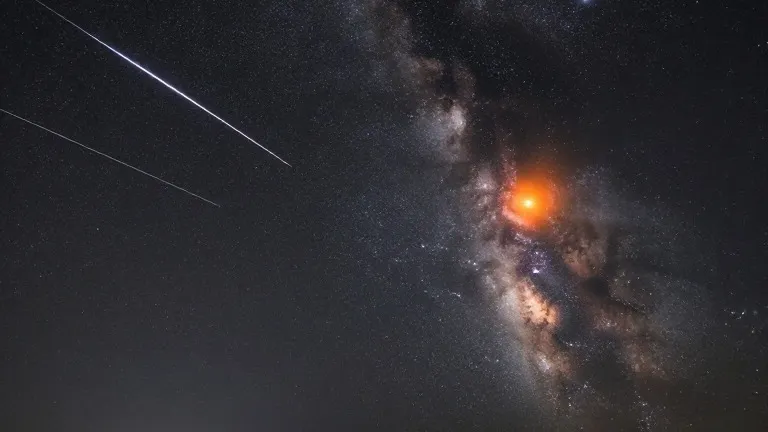
Residents of Toccoa, Georgia, witnessed a brief but visible display of celestial activity earlier this week. On the night of Oct. 21, astrophotographer Tim McCollum captured three distinct meteors streaking across the sky. These events occurred as the Orionid meteor shower approached its period of highest activity.
The glowing trails resulted from debris shed by Comet 1P/Halley. Although the comet itself is currently more than 3 billion miles from Earth, its lingering particles continue to interact with the atmosphere. When these fragments enter Earth's orbit, they burn up and create the visual phenomenon known as a meteor.
McCollum recorded the activity between 3 a.m. and 4 a.m. on Oct. 21. The meteors appeared to radiate from a specific point in the sky near the red giant star Betelgeuse. This radiant point lies within the constellation Orion. The visual pattern confirms the origin of the debris field intersecting with Earth's path.
Capturing such fleeting events requires specific technical equipment and precise timing. McCollum used a Canon EOS Ra camera paired with an RF 28-70 f2.0 lens. He employed a star tracker to maintain alignment with the radiant point. The final image is a composite of multiple 30-second exposures merged using PixInsight software.
The photograph includes other prominent astronomical features. The stars of Orion's Belt and the nearby Orion Nebula are visible on the right side of the frame. The Rosette Nebula, designated as Caldwell 49, also appears within the image. The diagonal band of the Milky Way's galactic plane provides the backdrop for these deep sky objects.
The Orionid shower remains active through Nov. 7. Observers in the coming days have additional opportunities to spot meteors from the Halley debris stream. This window allows for further visual confirmation of the annual display before it fades.
Observers may also encounter occasional bright fireballs from a different source. Earth is currently traversing debris streams from Comet 2P/Encke. These streams produce the Taurid meteor shower, which can generate brighter events known as Halloween Fireballs.
Source: Space.com