Sorbonne scientists replicate Mars cloud using rare ice physics
A new model explains how a 1,000-mile cloud forms near Arsia Mons by requiring humidity levels 100,000 times higher than Earth's maximum.
By Benjamin Rousseau ·
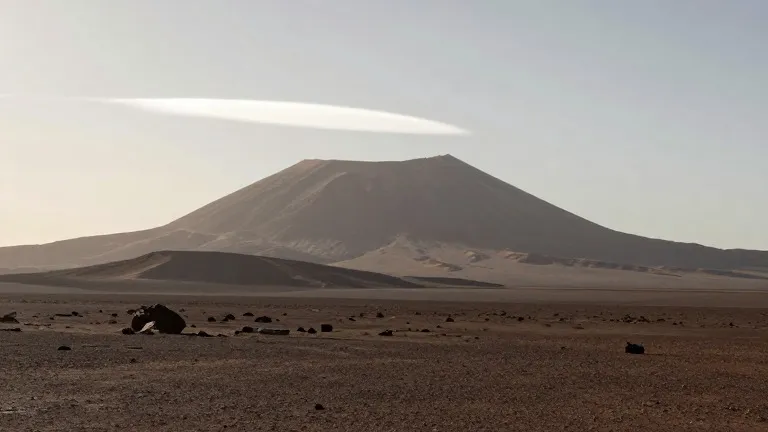
A research team at Sorbonne Université in Paris has successfully replicated the formation of a massive Martian cloud in a computer model. The study, published in Nature Geoscience, is the first to demonstrate that the feature requires a specific atmospheric process that has never been directly observed in nature.
The cloud in question, known as the Arsia Mons Elongated Cloud or AMEC, stretches over 1,000 miles. This length is comparable to the straight-line distance between New York and Kansas City. The cloud appears during Martian spring and summer, growing longer through the morning before dissipating. The cycle repeats over several months.
Scientists first detected the cloud in 2018 using a probe. For the past several years, researchers have attempted to explain its existence without success. The new model works only when it includes what lead author Jorge Hernández-Bernal describes as exotic physics. This mechanism, known as homogeneous nucleation, allows water vapor to turn directly into ice crystals without dust or salt particles to act as seeds.
Hernández-Bernal compared the process to condensation forming in the middle of an empty room rather than on a window. He called the discovery wholly unexpected. The physics is mentioned in textbooks but is generally treated as theoretical because it is thought to be too rare to occur naturally.
The model requires extreme conditions to trigger the cloud. Specifically, the temperature must drop by 30 degrees Celsius within 10 minutes. The volcano Arsia Mons, which stands 65,000 feet high, plays a central role in creating these conditions. When wind hits the volcano, it generates a powerful wave that lifts moist air high into the atmosphere in minutes.
The most striking requirement is the humidity level. The model shows that relative humidity must be more than 100,000 times greater than any value ever measured on Earth. Scientists previously assumed similar nucleation might happen in the upper atmospheres of planets like Venus or Earth, but the extreme humidity needed for Mars suggests why it had never been seen before.
Hernández-Bernal noted that the Martian atmosphere is much less understood than Earth's. He stated that reproducing the cloud to this degree is a remarkable achievement, as it confirms the existence of humidity levels on Mars that were previously unknown.
Source: Wired