Student List Targets 40 Percent to Break Serbia's 14-Year Ruling Grip
Polls suggest the student movement could capture nearly half the vote, challenging the Serbian Progressive Party in a race marred by violence and media bias.
By Michael Lombardi ·
Serbia’s Serbian Progressive Party (SNS) faces its most competitive challenge since 2012 as voters head to the polls on Sunday. The Student List, backed by a movement that has protested the government for nearly two years, targets more than 40 percent of the vote. Polls indicate the race is tight, with analysts describing the outcome as uncertain for the first time in the SNS’s 14-year tenure.
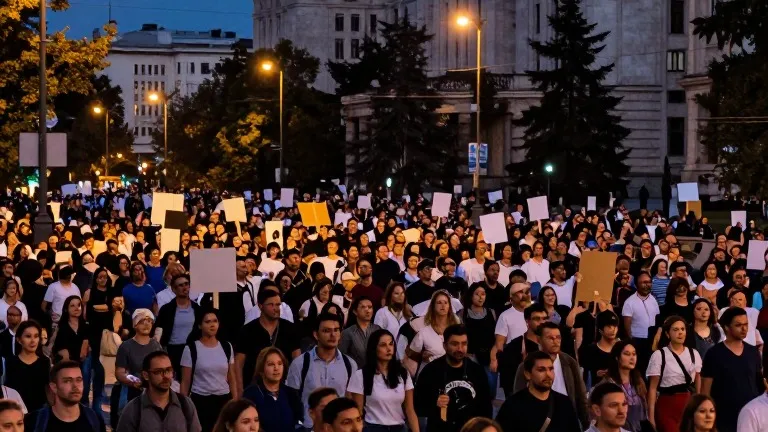
Thousands gathered in Belgrade on Thursday evening for the Student List’s final campaign rally. Many attendees had walked for days from across the country to reach the capital. Arsa Stojanovic, a biology student, told the crowd that the group had visited villages and neighborhoods nationwide and found widespread support. Aleksandar Cupic, a transport engineering professor and candidate, said the event "smells like freedom." The rally ended with a traditional circle dance.
The movement gained momentum after a concrete canopy collapsed at the Novi Sad railway station in November 2024, killing 16 people. Students framed the disaster as a symbol of institutional failure and corruption. They positioned the election as a chance to demand accountability and move beyond traditional ideological and foreign policy divisions that have historically defined Serbian politics.
The SNS held a rival closing rally a few kilometers away. The party framed the vote as a choice between stability and chaos. Former President Aleksandar Vucic accused opponents of serving foreign interests and said they had attacked the party with billions of euros. The SNS message emphasized continuity and prosperity, warning that a change in government risks disrupting the country’s sovereignty.
The campaign was marked by frequent incidents of conflict. The independent monitoring group CRTA recorded 116 cases of physical violence or verbal threats by the final week. These incidents included attacks on campaigners and attempts to seize campaign banners. CRTA noted that opposition activists, particularly those linked to the Student List, faced surveillance and police questioning. The group found that national television airtime favored the government, with almost three-quarters of time allocated to government representatives. More than 80 percent of coverage regarding the Student List was negative.
Reports of irregularities emerged during the final days of campaigning. The Balkan Investigative Reporting Network published testimony from a former SNS member describing pressure on public-sector employees to deliver votes. Anonymous sources told Deutsche Welle that voters were offered between €30 and €150, and sometimes holiday packages, to support the SNS. Independent media also reported on alleged links between people connected to the party and criminal networks, though political scientist Dusan Spasojevic doubted these reports would alter the election result.
Authorities have warned for weeks about potential street violence on election night. Several individuals have been arrested on suspicion of plotting disturbances. Spasojevic stated that a decisive win for either side would be ideal, but polls point to a narrow margin. He added that a close SNS victory would almost certainly be contested, as the student movement has vowed to defend every vote.
The European Union is watching the election closely. An EU Commission spokesperson said that key recommendations for improving Serbia's electoral framework remain unimplemented. The spokesperson stressed that democracy and the rule of law are central to Serbia's accession process. Serbia has held candidate country status since 2012.
Source: Deutsche Welle