640,000 First-Time Israelis Set to Vote Tuesday
The Israel Democracy Institute estimates that nearly 10% of the electorate will cast a ballot for the first time, potentially determining the fate of 12 Knesset seats.
By Benjamin Rousseau ·
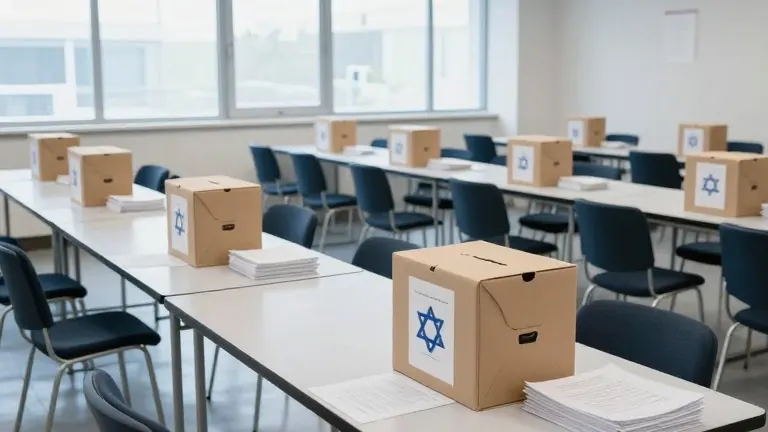
Israelis go to the polls on Tuesday, October 27, for a general election in which a new generation of voters holds measurable influence over the outcome.
The Israel Democracy Institute, or IDI, estimates that 640,000 citizens aged 18 to 22 are eligible to vote. This group constitutes nearly 10% of the total electorate. The institute calculates that their collective choices could determine as many as 12 seats in the 120-member Knesset.
This demographic weight stems from the country's demographic structure and recent political volatility. Tammy Hoffman, head of the education policy program at the IDI, noted that Israel has a high birth rate. She stated that high turnout among this group, which her research predicts, will make a difference. The IDI co-sponsored a recent event in Tel Aviv with the Yigal Allon Center to address more than 1,000 of these first-time voters.
Many of the attendees are in pre-military preparation programs. Yael Chernyvsky, 18, from Ramat Hasharon, participates in an army preparation course in the Negev. She told the Jewish Telegraphic Agency that she is voting to change the country's future. Chernyvsky blames Prime Minister Benjamin Netanyahu's government for national problems. She has not chosen a party but expects to support either the Democrats, led by Yair Golan, or Yashar, led by Gadi Eisenkot. Both parties belong to the opposition bloc seeking to remove Netanyahu, who has led the country since 2009 except for a brief period between 2021 and 2022.
Surveys indicate high intent to vote among this demographic. A May IDI survey found that 80% to 95% of prospective first-time Jewish and Arab voters said they would definitely or probably vote. Secular Jewish youth showed the highest certainty, while 87% of Arab respondents intended to vote. A separate poll for Ynet and Yedioth Ahronoth found 67% of young respondents certain they would vote and 19% thinking they would.
These figures compare to a 47% youth turnout in the 2024 United States presidential election, according to the Center for Information and Research on Civic Learning and Engagement. Hoffman attributed the high Israeli intent to the specific experiences of this cohort. She noted that these young people were in junior high during the pandemic, witnessed the judicial reform protests, and lived through the events of October 7.
National security and the cost of life rank as the top concerns for both Jewish and Arab young voters. Hoffman said military service could influence political leanings by raising questions about war objectives. An N12 poll conducted on September 23 found that 74% of young people described their views as right-wing or center-right, while 23% identified as left-wing or center-left. In that same poll, 16% intended to vote for Eisenkot's Yashar party and 14% for Netanyahu's Likud.
Individual motivations vary across the political spectrum. Omer Gross, an 18-year-old from Jerusalem in a preparation program in the Golan, plans to vote for the Religious Zionist party. He supports the policies of party leaders Bezalel Smotrich and Moshe Feiglin regarding the West Bank. His program-mate, Tomer Shiloh, 18, from Herzliya, will vote for the change bloc to force ultra-Orthodox men into military service and lower living costs.
A 22-year-old reservist, identified as Sergeant M due to IDF anonymity rules, cites economic factors such as tuition and housing costs as his primary reason to vote for the Democrats. Khalel Alaa Sabeh, 18, from Shef-Amra, wants an Arab party that closes resource gaps and tackles crime. He said he is urging friends to vote and added, "I won't leave the country. This is my land, this is my home."
The election takes place against a backdrop of shifting political alignments. Hoffman noted that Jewish Israeli voters have moved rightward over the past two decades. However, mock elections in high schools showed most students backing Yashar and Beyachad, the latter led by former prime ministers Naftali Bennett and Yair Lapid. Some support exists for Likud, while support for Itamar Ben-Gvir's far-right party remains low among this group.
Source: The Jerusalem Post
More Politics · World news · Report a business · Got a Story?