4.3 Million Votes: Lula Overtakes Flávio Bolsonaro in Runoff
The 80-year-old former leader erased a 2.2 million vote deficit from the first round to secure his fourth term as Brazil's president.
By Benjamin Rousseau ·
Luiz Inácio Lula da Silva won a fourth term as president of Brazil on Sunday, defeating far-right challenger Flávio Bolsonaro in a runoff election. With nearly 99% of ballots counted, Lula received 51.75% of the vote. Bolsonaro, 45, received 48.25%. The result confirms Lula, who turns 81 on Tuesday, as the country's next leader after a dramatic reversal of earlier polling data.
The victory followed a steep climb from the first round held in early October. At that time, Lula trailed Bolsonaro by 2.2 million votes. By the end of the second round, he had accumulated a lead of 4.3 million votes. This outcome breaks a historical pattern in Brazilian politics. Since the return to democracy in the 1980s, no candidate who finished second in the first round had previously advanced to win the runoff.
Turnout shifts appear to have driven the margin of victory. Abstention rates dropped from a record 21.08% in the first round to 19.21% in the runoff. Lula’s allies had identified this trend as his primary advantage. His supporters often live farther from polling stations, meaning high abstention rates historically hurt his base more than his opponent's.
Reginaldo Lopes, a key ally of the president-elect, described the moment of confirmation as "incredible." He stated that Brazil was sending a message to the world regarding the extreme right. Lopes said the country would now "reorganize the democratic forces." The win serves as a major setback for the Bolsonaro family and their international allies.
Jair Bolsonaro, the father of the defeated candidate, is serving a 27-year sentence for plotting a coup. He lives under house arrest in Brasília, where his son watched the count. The result was met with anger and bewilderment in the Bolsonaro household. Jair Bolsonaro had hoped his son would win and lead to his release and a role in the new government. The loss also impacts US President Donald Trump, who had hoped Brazil would join other pro-Trump leaders in Latin America.
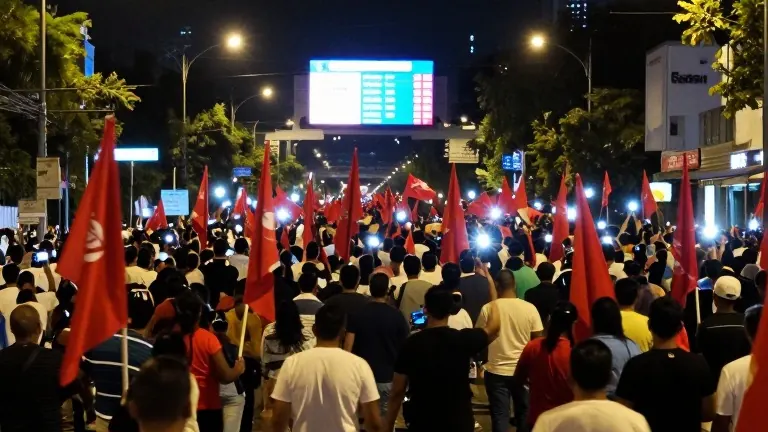
Supporters demonstrated their strength in the days before the vote. More than a million people gathered on Copacabana beach in Rio de Janeiro on Saturday. A larger crowd marched on Paulista Avenue in São Paulo. These rallies followed weeks of student-led protests against the Bolsonaro family. On Sunday evening, hundreds returned to Paulista Avenue to watch the final count, waving red flags.
Tension marked the voting day in São Paulo. Pro-Bolsonaro politicians allegedly attempted to disrupt the vote by sabotaging public transport in areas that lean toward Lula. The effort failed. Lucas Lopes, 32, called the incident "another coup attempt." Caio Marques, a 40-year-old photographer from Franca, noted that the opposition had woken up in the second round after the left's struggles in the first.
Source: The Guardian
More Politics · World news · Report a business · Got a Story?