Team Apparel Orders: How Sizing Errors Cost Money
Printed shirts cannot be returned, so bulk buyers must adjust for brand differences, cotton shrinkage, and print scaling to avoid inventory waste.
By Amira Patel ·
Once a team logo is printed on a jersey, the garment is locked in. If the shirt is too small or too large, it cannot be resold. Vendors report that four specific sizing errors dominate bulk orders. Correcting these mistakes before production begins is the only way to avoid ending up with unused inventory.
Many groups assume an even split across sizes is a safe bet. Ten of each size is a common starting point, but it often results in a surplus of smaller and larger shirts. Adult orders typically skew toward large, medium, and extra-large, which together account for roughly 74% of the total. Small and double-extra-large sizes make up the next tier, while triple-extra-large is rare. Collecting individual size requests from each member is more accurate than guessing, even if the process takes a week.
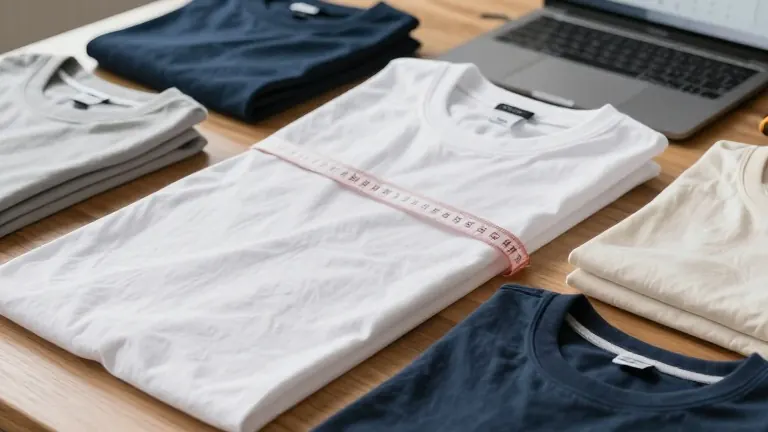
Brand labels do not guarantee a consistent fit across different manufacturers. A women's medium cut often fits like a unisex small, while semi-fitted styles run smaller than classic tees. To verify fit, buyers should measure a well-fitting shirt flat across the chest, about one inch below the armhole, and compare that number to the vendor's chart. Mixing different blank styles in a single order increases the risk of inconsistency. Sticking to one style prevents two shirts labeled large from differing by a full size.
Natural fibers change dimension after washing. A preshrunk 100% cotton tee can lose 2% to 5% of its length and 1% to 3% of its width, primarily after the first cycle. On a large shirt, this shrinkage can equal one or two inches. Polyester blends hold their shape better under heat and agitation. Teams that wash garments in hot water and dryers should consider ordering up one size in cotton or selecting a blend. Washing a sample shirt before the full order goes to print is a standard method to predict final dimensions.
Artwork must scale with the garment size. A design sized for a medium will appear tiny on a triple-extra-large and overwhelming on a youth small. Chest prints typically range from 10 inches wide on a women's small to 12 inches on a men's large. Left-chest logos are usually around 3.5 inches wide, while front-center placement sits 2.5 to 3.5 inches below the collar seam. Printers can scale files in groups, such as youth, small through large, and 2XL up, often at no extra cost. Approving proofs for the smallest and largest sizes verifies that the middle sizes will fit correctly.
Buying 5% to 10% extra in medium and large sizes covers late additions or second-guessing. Extra stock in extreme sizes is rarely used. Providing a detailed size sheet with specific brand and cut information allows vendors to flag discrepancies. Printers handle hundreds of orders annually and can identify when a team of 20 lists nine smalls, which suggests a data entry error.
Source: Yonkers Times
More Business · Watch Your Wallet · Report a business · Got a Story?