Hebrew University Professor Integrates Practical AI Skills Into Data Science Curriculum
An Argentine-born academic uses her industry experience to teach students how to critically evaluate and utilize artificial intelligence in their academic work.
By Benjamin Rousseau ·
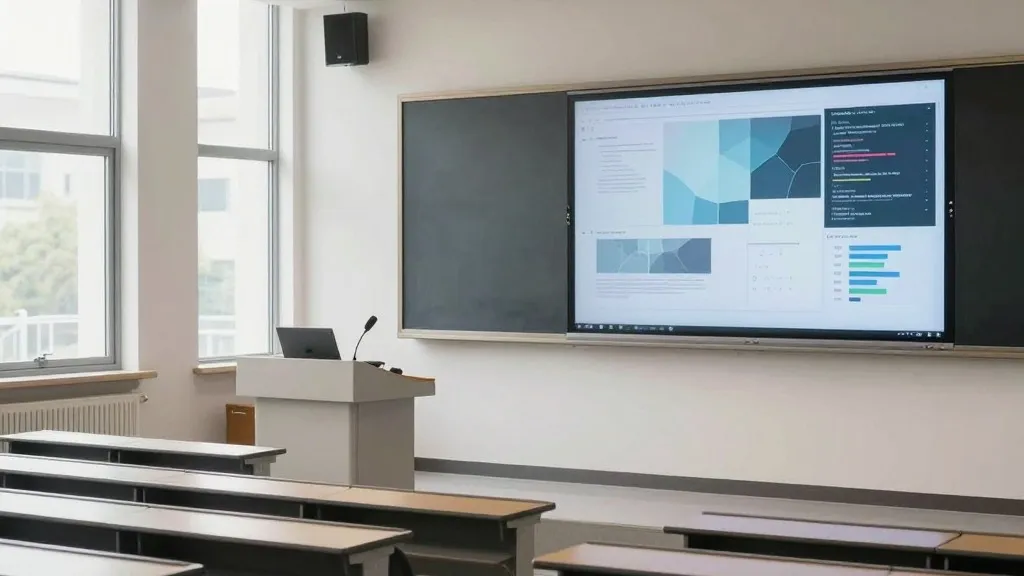
A new approach to teaching artificial intelligence is taking shape at the Hebrew University Business School in Jerusalem, where students are learning to use AI tools as critical partners rather than passive answer generators. The initiative is led by Claudia V. Goldman, an associate professor in the Data Science Department who has been with the institution since July 2024. Her primary objective is to demonstrate how these technologies can be applied to solve tangible, real-world problems.
Goldman brings a substantial background to the classroom, holding 24 patents and having published more than 50 academic papers. Her career has spanned both academia and major industry players. She served as a team leader at Samsung Telecom Research in Herzliya for three years and spent 15 years as a research scientist in General Motors' research and development organization. At GM, she focused on introducing learning agents into vehicle user experiences to help drivers understand autonomous functions. Prior to her industry work, she held research positions at Bar-Ilan University, the University of Massachusetts Amherst, and the University of Haifa between 1999 and 2005.
The professor’s path to Israel began when she was a teenager. Born in Argentina, she moved to Israel with her family in January 1984. She completed high school in Jerusalem in 1986 and subsequently served in the army. She then earned three degrees from the Hebrew University, including a BSc in computer science, mathematics, and electronics in 1991, an MSc in computer science in 1993, and a PhD in computer science in 1999 under the supervision of Prof. Jeff Rosenschein.
In her current role, Goldman has established clear guidelines for student interaction with AI. She explicitly defines when and why students may employ these tools, requiring them to credit the technology and explain their specific usage. She has stated that fully AI-generated answers are not accepted and that she can detect machine-generated writing. Instead, she encourages students to brainstorm with AI while maintaining a critical perspective, such as checking for bias or verifying the existence of cited sources.
To assess understanding, she relies on a mix of classwork, presentations, and peer-organized activities. This method allows for in-person evaluation of student comprehension. The curriculum also addresses broader topics, including human responsibility, values, and the kind of professionals students should aim to become. The Business School offers specific courses in this domain, such as AI for Social Good and Responsible AI. Additionally, the university’s Free Listener Program allows senior citizens to audit courses as the fall semester begins.
Goldman also weighed in on the concept of 'Human Reserved' jobs, a suggestion previously made by Bill Gates. She noted that the issue is not a simple binary choice about which professions remain human. Rather, she views it as a matter of understanding the benefits AI provides in different contexts and identifying the critical skills needed to strengthen those roles.
On a personal note, Goldman shared that her grandparents emigrated to Argentina before relatives were killed in the Holocaust. As their only child, she attended a Jewish school in Buenos Aires where she studied Yiddish, Hebrew, and Spanish. Her father had long desired to leave Argentina, and in 1983, Goldman told him, 'The only place I can see myself growing up is Israel.' The family made aliyah six months later. She later met her husband, Prof. Roy Shenhar, on the Givat Ram campus in 1995. After running into him three times, he bought her ice cream in accordance with Hebrew custom, and they married in 1999.
Source: The Jerusalem Post