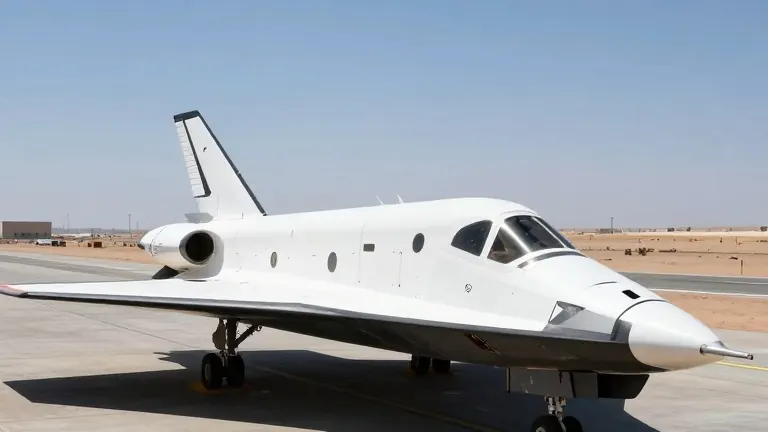
Swift Observatory: NASA Telescope Scheduled for Atmospheric Reentry
The 22-year-old observatory will burn up in the atmosphere this Friday after a robotic rescue mission failed to stabilize its orbit.
By Benjamin Rousseau ·
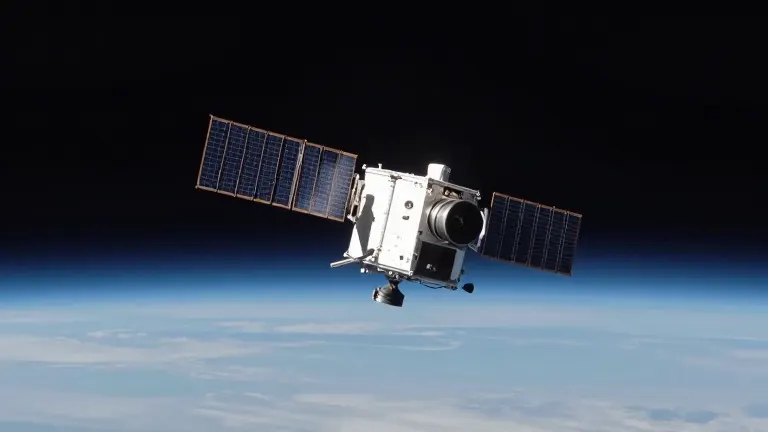
The U.S. Space Force predicts that the NASA Swift Observatory will reenter Earth’s atmosphere on or around Friday, October 31. The 1.5-ton telescope has been in low-Earth orbit since November 20, 2004. Its orbital decay accelerated in recent years due to intense solar activity, which increased atmospheric drag on the spacecraft. The mission’s chief scientist, Brad Cenko, stated that most of the telescope will burn up during reentry. However, he noted that denser components, including tungsten parts and some mirrors, may survive the descent. These surviving fragments are most likely to land in the ocean, though the reentry zone includes parts of Africa, Australia, India, Southeast Asia, and Central and South America.
Swift was designed to detect gamma-ray bursts and supernovae. During its operational career, the telescope identified more than 2,000 gamma-ray bursts and 1,400 exploding stars. It also tracked comets, asteroids, and black holes. John Nousek, an astronomer at Penn State University who led the control team, described the end of the mission as a necessary conclusion for any object in low-Earth orbit. He noted that the team has expected this final phase since before the spacecraft launched in 2004.
NASA attempted to extend the telescope's life by hiring Katalyst Space one year ago to perform a rescue. The company launched a robotic arm named Link in July. The robot launched to approach the Swift Observatory but failed to close the distance beyond 7 to 9 miles, or 12 to 15 kilometers. Link subsequently plunged back to Earth in September. After the rescue attempt was aborted, Swift resumed its scientific observations. The telescope continued to gather data until late October, when it dropped to an altitude that prevented stable tracking. At that point, its systems were shut down.
The Swift Observatory served as a rapid-response instrument for other major telescopes. Its ability to swivel quickly allowed it to alert the Hubble and Webb space telescopes to transient celestial events, enabling those instruments to conduct deeper investigations. Nousek expressed the team's hope that the lessons learned from Swift's success will inform the design of future space missions. The Space Force continues to track the telescope's path as it approaches the atmosphere.
Source: The Aegis